 1 Light Bulb and 3 Switches Puzzle
The one light bulb and three switches puzzle has been asked several times in interviews to evaluate candidate’s analytical skills.
Puzzle
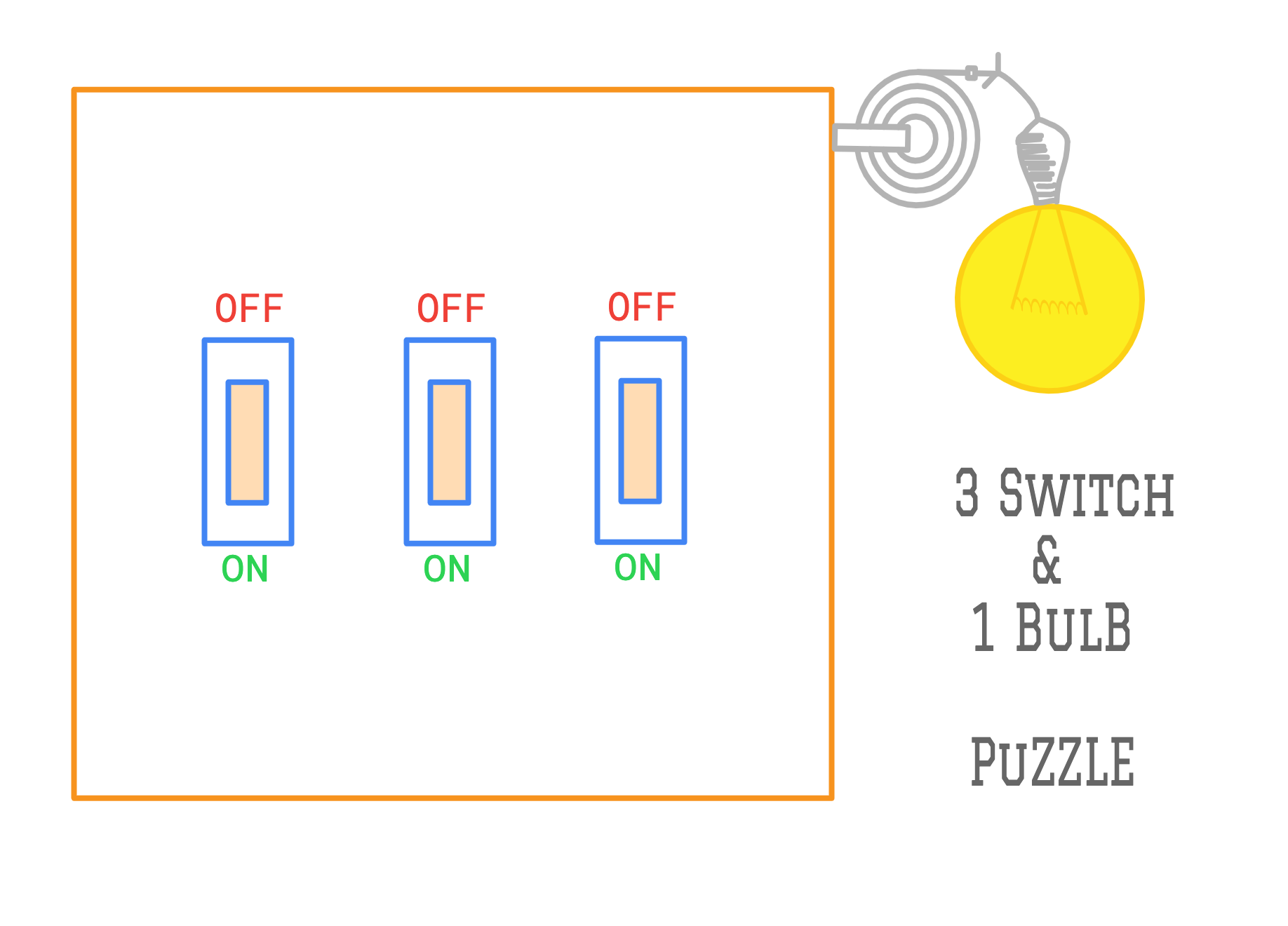
How do you figure out which switch belongs to the light?
Think for a while before looking at the solution.
Why On/Off Alone Isn’t Enough
The instinctive first attempt is to flip switches one at a time and open the door after each one — but you’re only allowed to open the door once, so that’s out immediately. The next instinct is to flip some combination of switches and then read the bulb’s on/off state through the door. That doesn’t work either, and it’s worth being precise about why: when you open the door, a plain light switch gives you exactly one bit of information — the bulb is either on or off. One bit can only distinguish between 2 possibilities, but you have 3 switches to tell apart. No matter how cleverly you sequence on/off flips beforehand, the single observation “on” or “off” can never by itself pin down which one of three switches is responsible.
To solve it, you need a third distinguishable state to observe besides “on” and “off” — and that’s where heat comes in. A traditional incandescent bulb heats its filament to produce light, and that filament stays noticeably warm for a few minutes after power is cut. So a bulb can be in one of three states when you walk in: on (warm, lit), off and warm (was recently on), or off and cold (was never turned on). Three states for three switches — that’s the missing piece.
(Note: this trick relies on incandescent-style heat. It doesn’t work with most LED or CFL bulbs, which run cool enough that “off and warm” isn’t a reliable signal — assume the puzzle means a traditional incandescent bulb.)
Solution
Label the switches 1, 2, and 3. Assume all three start off.
- Turn switch 1 on and leave it on for about two minutes.
- Turn switch 1 off, then immediately turn switch 2 on.
- Leaving switch 2 on and switch 3 off, open the door and observe the bulb — this is your one and only look.
Now match what you see to a switch:
- Bulb is on → the only switch currently supplying power is switch 2, so switch 2 controls the bulb.
- Bulb is off, but warm to the touch → it isn’t receiving power right now (ruling out switch 2), but it was powered recently long enough to heat up — that’s the two minutes switch 1 was on. So switch 1 controls the bulb.
- Bulb is off and cold → it received no power at any point in this sequence, which rules out both switch 1 and switch 2 by elimination. So switch 3 controls the bulb.
These three outcomes are exhaustive and mutually exclusive — every possible thing you could see through that door maps to exactly one switch, which is what makes this a complete solution rather than a lucky guess. The two-minute wait in step 1 isn’t arbitrary either: it just needs to be long enough for the filament to heat up perceptibly and short enough that it hasn’t fully cooled by the time you check it a few minutes later in step 3.