 Disable Whitelabel Error Page in Spring Boot
Page content
In this article, we’ll learn how to disable default Whitelabel Error Page in Spring Boot.
Whitelabel Error Page
Whitelabel error page appears when you hit a url which result into HTTP error. Whitelabel error page is generated by Spring Boot as a default mechanism when no custom error page is found.
Let’s hit a wrong or unknown url, which result into HTTP 404 error:-
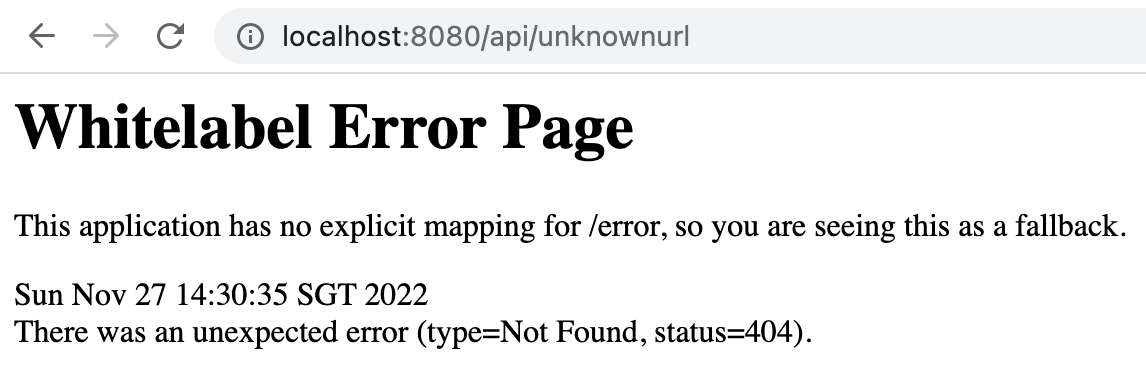
If you don’t want to see this default Whitelabel error page then it can be disabled using any one of these two properties:-
- Disable Whitelabel Error Server Property
server.error.whitelabel.enabled = false - Exclude ErrorMvcAutoConfiguration
spring.autoconfigure.exclude = org.springframework.boot.autoconfigure.web.servlet.error.ErrorMvcAutoConfiguration

## For Spring Boot < 2.0
spring.autoconfigure.exclude = org.springframework.boot.autoconfigure.web.ErrorMvcAutoConfiguration
When Whitelabel error page is disabled and no custom error page is provided, you will see the error page generated by underlying web application server such as Tomcat, Undertow, Jetty etc.
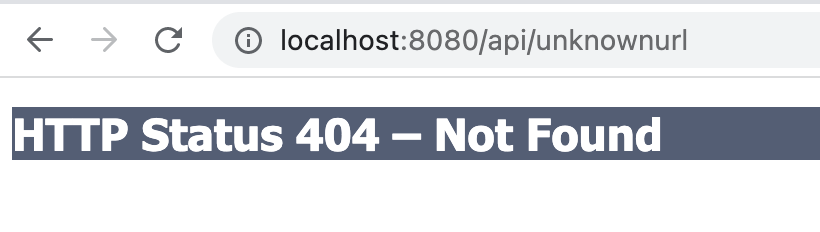
Follow the post for Customize Whitelabel HTML Error Page using Thymeleaf
Disable Whitelabel Error Server Property
You can disable the Whitelabel error page by setting the server.error.whitelabel.enabled property to false. This can be done from .properties file, .yml file, or through command-line parameters as follows:-
## application.properties
server.error.whitelabel.enabled = false
## application.yml
server:
  error:
    whitelabel:
      enabled: false
$ java -jar -Dserver.error.whitelabel.enabled=false spring-boot-app-1.0.jar
$ java -jar spring-boot-app-1.0.jar --server.error.whitelabel.enabled=false
Exclude ErrorMvcAutoConfiguration
Another way to disable it via excluding the ErrorMvcAutoConfiguration from auto configuration. This can be done easily from .properties file or .yml file
## application.properties
spring.autoconfigure.exclude = org.springframework.boot.autoconfigure.web.servlet.error.ErrorMvcAutoConfiguration
## application.yml
spring:
  autoconfigure:
    exclude: org.springframework.boot.autoconfigure.web.servlet.error.ErrorMvcAutoConfiguration
Alternatively, you can also use @EnableAutoConfiguration annotation to exclude it.
import org.springframework.context.annotation.Configuration;
import org.springframework.boot.autoconfigure.web.servlet.error.ErrorMvcAutoConfiguration;
...
@Configuration
@EnableAutoConfiguration(exclude = {ErrorMvcAutoConfiguration.class})
public static MainApp { ... }
For Spring Boot < 2.0
Please note that for Spring Boot < 2.0, the ErrorMvcAutoConfiguration class is located in package org.springframework.boot.autoconfigure.web.
## application.properties
spring.autoconfigure.exclude = org.springframework.boot.autoconfigure.web.ErrorMvcAutoConfiguration

## application.yml
spring:
  autoconfigure:
    exclude: org.springframework.boot.autoconfigure.web.ErrorMvcAutoConfiguration
Debugging: See the Real Error Instead of Just Hiding the Page
Disabling the Whitelabel page only removes the generic page — it doesn’t tell you why the request failed. If you got here because your app is throwing an unexpected error, you usually want the actual exception message and stack trace, not just a different-looking blank error.
By default, Spring Boot deliberately hides these details for security reasons — leaking a stack trace or exception message to a client can expose internal implementation details. Since Spring Boot 2.3, server.error.include-message and server.error.include-stacktrace both default to never, and this hasn’t changed in Spring Boot 3.x.
To see them for local debugging, set:
server.error.include-message = always
server.error.include-stacktrace = always
server.error.include-binding-errors = always
Each of these properties accepts one of three values:
never— the attribute is never included (the default)always— the attribute is always includedon-param— the attribute is included only when the request has a matching query parameter (e.g.?trace=true), which is a safer middle ground for a shared/staging environment than leaving it onalways
Never set these to always in production. Use on-param if you need occasional access to the details on a shared environment, and keep production defaulted to never so you don’t leak stack traces to end users.